
The Seminar Funnel Explained
Why most real estate education is structured the way it is.
If you've spent any time exploring real estate investing education, you've likely seen a familiar pattern.
A free webinar.
A weekend seminar.
A multi-day bootcamp.
A mentorship program.
At first glance, these appear to be separate educational offerings.
But in most cases, they are not separate products.
They are stages inside a customer acquisition funnel.
Understanding this structure doesn't mean the education has no value.
But it does explain why the industry is PRICED the way it is.
Most Seminar Companies Operate a Multi-Stage Funnel
Stage 1 — Free Event
Often marketed as:
Free webinars
Free local workshops
Free real estate training
Purpose: Introduce the instructor, build credibility, and identify interested attendees.
Stage 2 — Introductory Course ($997 – $2,000)
Often presented as:
A starter system
A foundational program
A basic real estate course
Purpose: Filter for students willing to invest financially in the topic.
Stage 3 — Bootcamp ($5,000 – $10,000)
Often marketed as:
Intensive training
Implementation workshops
Strategy deep dives
Purpose: Deliver more education to identify students interested in higher-tier mentorship.
Stage 4 — Mentorship / Coaching ($15,000 – $40,000+)
Often described as:
Inner circle programs
Advanced mentorship
Elite masterminds
Purpose: Provide deeper support and direct access to instructors.
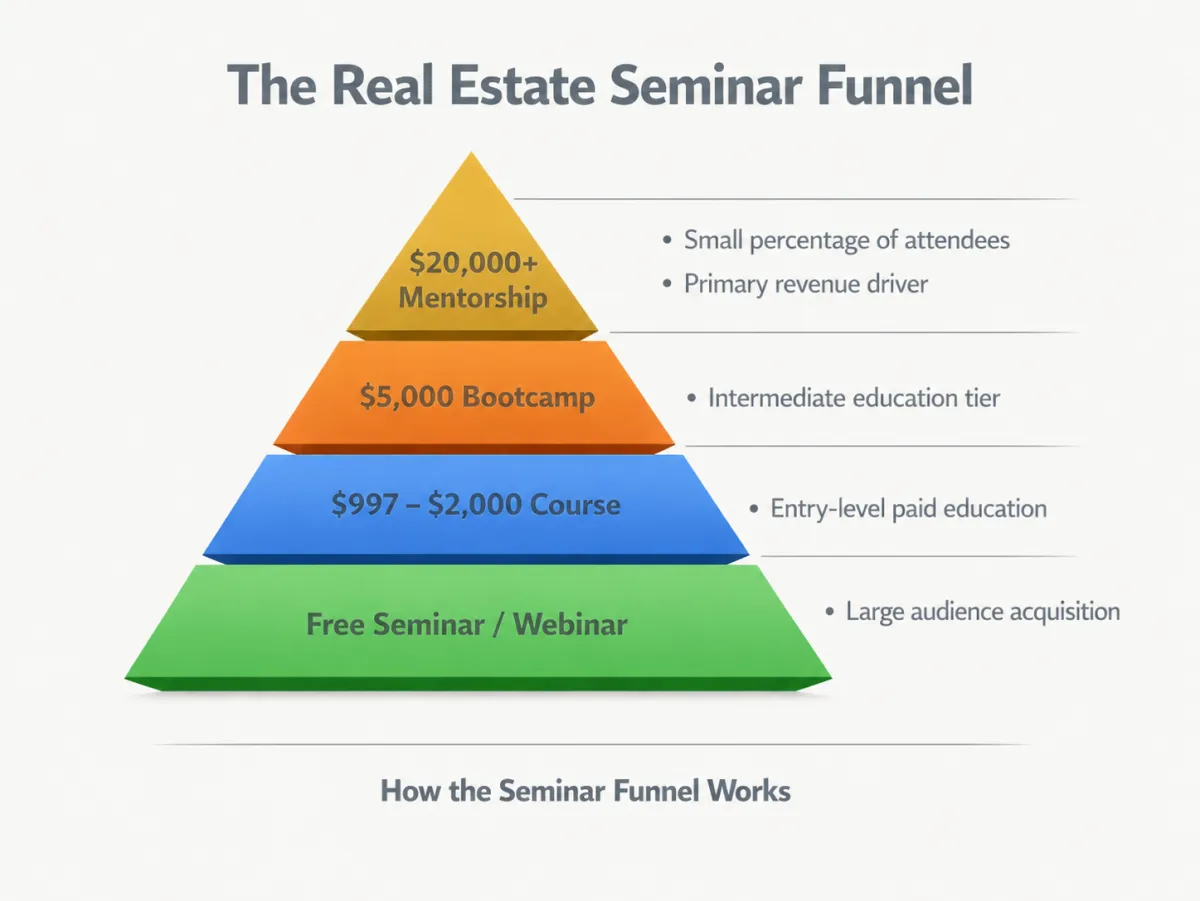
Large numbers of people attend free seminars or webinars.
A small percentage purchase entry-level courses.
A smaller percentage move into bootcamps.
And an even smaller percentage enroll in high-ticket mentorship programs.
Because marketing and events are expensive, the model depends on selling higher-ticket programs to some attendees.
Understanding this structure helps explain why advanced real estate education programs can reach $10,000–$50,000+.
This Structure Is Not Unique to Real Estate
The multi-stage funnel model exists across many industries:
• Business coaching
• Online education
• Consulting programs
• High-Ticket Pricing
It allows companies to:
• Reach large audiences
• Identify highly motivated students
• Provide increasing levels of support
This model can be effective for companies and students alike. But it also means something important.
Most of the core knowledge is distributed across multiple paid layers.
Where Confusion Often Happens
Many aspiring investors enter the industry expecting a simple education path.
Instead, they encounter a ladder of programs that gradually unlock deeper information.
This can create a common experience:
1) Attend a free event.
2) Purchase a starter course.
3) Discover additional advanced programs.
4) Decide whether to continue investing in education.
For some students, this works well. For others, it can feel confusing or expensive.
The Strategies Themselves Are Not the Secret
Across hundreds of seminars and instructors, the same core investment frameworks appear repeatedly:
• Wholesaling
• Creative Finance
• Buy-and-Hold
• Fix-n-Flip
• Tax Liens/Deeds
• Notes/Paper
The differences are usually in:
• Presentation
• Marketing
• Personal stories
• Deal examples
But the underlying mechanics of real estate investing are surprisingly consistent.
Understanding the System Before You Spend
Seminar Insider was built around a simple idea:
Before someone spends thousands of dollars on education,
they should understand the structure of the industry itself.
By organizing strategies, deal structures, and educational frameworks into one system,
we aim to make real estate investing easier to study and evaluate.
Not by replacing seminars. But by helping people understand the landscape before entering it.
Explore the Strategies Without the Funnel
Seminar Insider organizes the core strategies taught across the real estate education industry into a structured, AI-powered research platform.
Understand deals. Study strategies. Explore investment models.
Before spending thousands on education.
Seminar Insider is an independent education platform.
We are not affiliated with, endorsed by, or partnered with any named seminar organization.
© 2026 Seminar Insider. All rights reserved.